Crypto Continues to Flow Through Sihanoukville Casinos Despite Cambodia's Crackdown

Key takeaways
- Between January 1 and September 7, 2026, 34 in-person casinos in Sihanoukville, Cambodia, received about USD 1.07 billion in crypto, according to TRM Labs data
- Three casino entities tied to networks designated by the US Treasury's Office of Foreign Assets Control (OFAC) received more than USD 320 million after their designation dates
- USDT on TRON accounted for 99.9% of the volume
- Monthly inflows fell from an average of USD 148 million in January–May to about USD 95 million in July and August, but have not stopped
- Casinos convert USDT to cash with little apparent customer due diligence, and pawnshops, supermarkets, and exchange counters across the city offer crypto-to-cash services
{{horizontal-line}}
The crackdown and the designations
Sihanoukville became one of Southeast Asia's main hubs for scam compounds, with casinos, hotels, and exchange shops serving the people who ran and staffed them. Over the past year, the Cambodian government has publicized raids on the compounds and presented the crackdown as a turning point. On September 8, 2026, the country's anti-scam commission said it had revoked 18 casino licenses and suspended nine.
International pressure has also increased. On April 23, 2026, OFAC designated Cambodian Senator Kok An and 28 individuals and entities in his network for their roles in scam center operations that defrauded Americans. The designations included Huan Hai Bo Lai International Investment Co Ltd (Huan Hai) and Xihu Resort Hotel Co Ltd, which operates a Sihanoukville casino. According to Treasury, US-based individuals who supported the network laundered more than USD 73 million, and the US Secret Service took action against them in 2024. The action followed OFAC's October 2025 designation of the Prince Group and 146 related targets, including Jin Bei Group, and the Justice Department's launch of the Scam Center Strike Force in November 2025.
Onchain data and TRM field observations in Sihanoukville show that crypto kept reaching the city's casinos in 2026, including casinos tied to designated networks, even as the wider economy around the compounds contracted.
Crypto inflows to Sihanoukville casinos in 2026
TRM tracks in-person casinos attributed to Sihanoukville, including casinos tied to networks OFAC has designated. Between January 1 and September 7, 2026, 34 of these casinos received about USD 1.07 billion in crypto. Casinos tied to designated networks accounted for USD 687 million, or 64% of the total.
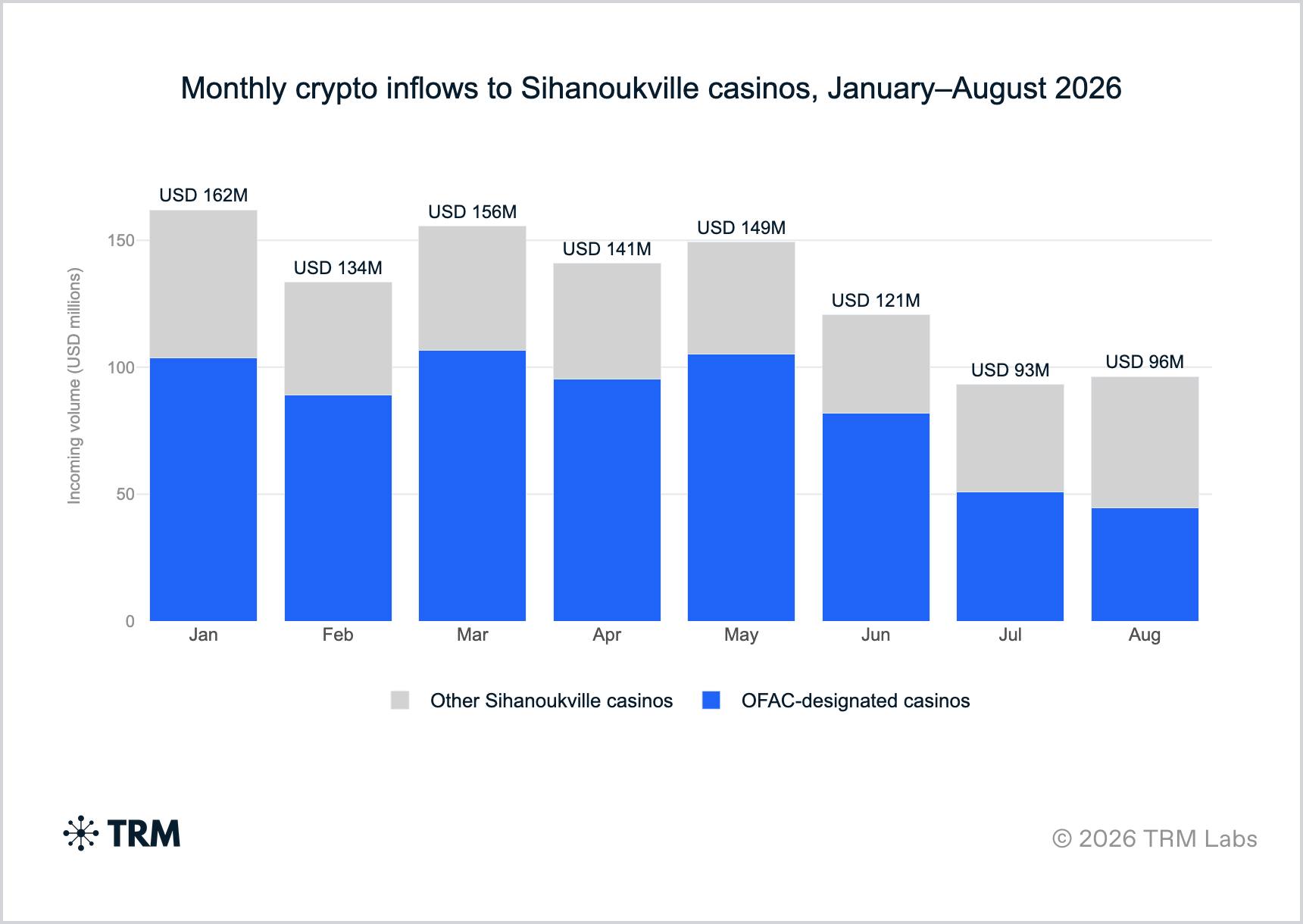
Monthly inflows averaged USD 148 million from January to May, then fell to about USD 95 million in July and August. Most of that decline came from the designated casinos, whose monthly inflows dropped from an average of USD 100 million to about USD 48 million. Some of the decline may reflect operators moving to new wallets that TRM has not yet attributed, so the figures may overstate how far activity fell.
The designated casinos continued to receive funds after the designations. From April 23 through September 7, 2026, entities TRM attributes to the Xihu casino received USD 184 million and entities attributed to Huan Hai received USD 129 million. A casino associated with Jin Bei Group received USD 9 million after the October 2025 Prince Group designation.
Frequent wallet changes limit comparisons with 2025 for most of these casinos. Huan Hai, whose wallets TRM can follow further back, received USD 264 million between January 1 and September 7, 2026, up from USD 90 million over the same period in 2025. Huan Hai serves a different clientele from many of the smaller casinos in the city, so its growth may not reflect the whole sector.
Field observations in Sihanoukville
Sihanoukville is quieter than it was a year ago. Many of the exchange shops, service businesses, restaurants, and convenience stores that served the compound workforce have closed or scaled back. Casino operators describe floors that were regularly full in 2025 as now running well below capacity, and some establishments have shut down.
The crypto-to-cash infrastructure still works. Casinos continue to accept USDT directly at cashier desks, converting it to chips and back to US dollars with little apparent customer due diligence, although operators appear more cautious with unfamiliar visitors than before.
Outside the casinos, convenience stores, hotels, phone shops, pawnshops, and dedicated exchange counters across the city offer crypto-to-cash services. Some display "USDT Exchange" signs openly. Others appear to work by referral only.
USDT on TRON as the settlement layer
Of the USD 1.07 billion that reached Sihanoukville casinos in 2026, 99.9% was USDT on TRON. Every crypto-to-cash exchange TRM observed in the city also settled in USDT. Low fees, deep liquidity, and wide adoption across the region explain the preference, and the same rail has carried much of the region's scam proceeds for years.
Casino operators also rotate through new wallet addresses, which makes tracing harder and shrinks the set of addresses that can be attributed at any one time. Because of that rotation and the city's over-the-counter cash-out network, screening against a static list of addresses will miss much of the activity.
What this means for compliance teams and investigators
Cambodia's casino sector has long been identified as a channel for money laundering. OFAC's designations tie Sihanoukville casino operations directly to scam center networks, and TRM data shows casinos tied to those networks still receiving funds months after the designations.
The compounds have contracted, but the casinos, the exchange counters, and the USDT settlement layer have adapted and remain in operation. Funds have continued to reach designated casinos, and operators can move to new wallets and new premises quickly.
Exchanges and stablecoin issuers with Southeast Asian exposure should screen for indirect exposure to Cambodian casino and commercial entities in addition to direct hits on sanctioned addresses. They should also expect attributed wallets to be replaced.
TRM is tracking the casinos and cash-out services in Sihanoukville as they adapt. To learn how TRM helps compliance teams and investigators identify exposure to Southeast Asian scam and laundering networks, contact our team.
{{horizontal-line}}
Frequently asked questions (FAQs)
1. What is the link between Sihanoukville's casinos and scam compounds?
Many of Sihanoukville's scam compounds operated alongside or behind casinos, hotels, and resorts. The designations OFAC announced against the Kok An network on April 23, 2026, named companies operating Sihanoukville casinos, including Xihu Resort Hotel Co Ltd, and tied them to scam center operations that defrauded Americans. Casinos give these networks a way to convert crypto into chips and cash.
2. Which OFAC designations cover Sihanoukville casino operators?
On April 23, 2026, OFAC designated Senator Kok An and 28 related individuals and entities, including Huan Hai Bo Lai International Investment Co Ltd and Xihu Resort Hotel Co Ltd. On October 14, 2025, OFAC designated the Prince Group as a transnational criminal organization along with 146 related targets, including Jin Bei Group.
3. Why do Sihanoukville casinos use USDT on TRON?
USDT on TRON has low fees, deep liquidity, and wide adoption across Southeast Asia. In TRM data, 99.9% of 2026 crypto inflows to Sihanoukville casinos were USDT on TRON, and every crypto-to-cash exchange TRM observed in the city settled in USDT.
4. Did crypto inflows to Sihanoukville casinos fall after the crackdown?
Monthly inflows fell from an average of USD 148 million in January–May 2026 to about USD 95 million in July and August, but casinos continued to receive funds, including casinos tied to designated networks. Part of the decline may reflect wallet rotation. TRM's figures reflect current attribution and may be revised as TRM attributes more wallets, so they should be read as a baseline.
5. What should compliance teams watch for?
Screen for indirect exposure to Cambodian casinos, hotels, and commercial entities as well as direct exposure to sanctioned addresses. Expect operators to rotate wallets, and treat USDT flows to informal exchange counters in the region as a risk indicator.